
Destination guide
María del Mar and the clay of El Cercado
By Basso Lanzone, official Canary Islands tour guide
Meet María del Mar Santana González and discover the traditional pottery of El Cercado. Explore La Gomera’s people and stories with GetHoliday.
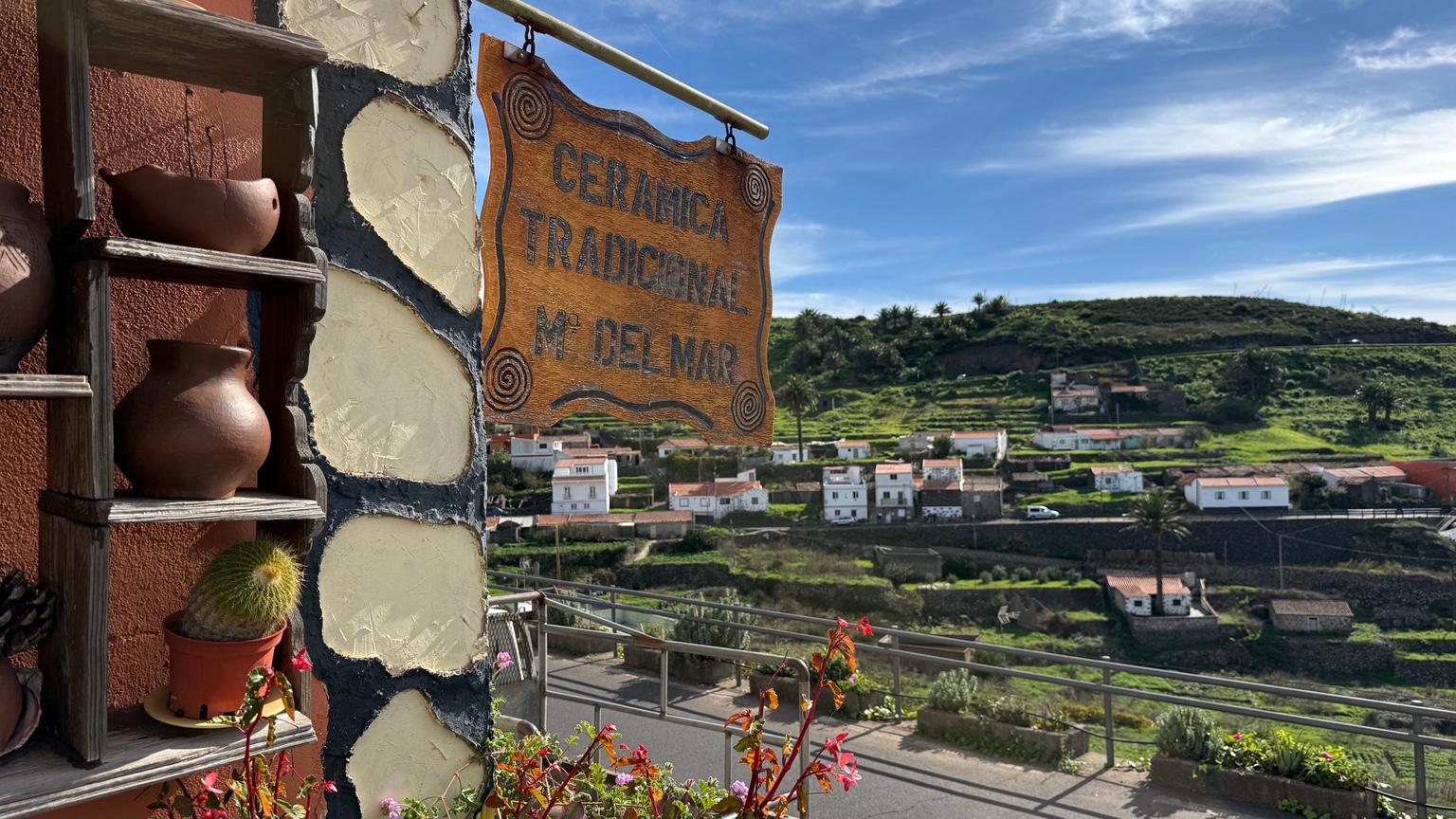
María del Mar’s workshop in El Cercado. Photograph by Basso Lanzone.
In El Cercado, a wooden sign reads «Cerámica tradicional M.ª del Mar». It hangs beside an earthenware jug, a small pot and a round cactus. Behind it are the village’s white houses and La Gomera’s green terraces. Of all the photographs of the island I could show you, today I would choose this one. That way, when you arrive, you will recognise the door.
María del Mar Santana González is a locera. I like introducing her with the word used here for the women who make earthenware. And if I could show you just one piece to explain why I am so fond of her craft, I would choose the simplest thing in the workshop, the potato dish.
Look at its shape. The boiled potatoes go in the middle, with a place for the mojo sauce at either end. Someone who knew the Gomera table very well thought about where a person sitting down to eat would dip their potato. And a woman knew how to give that idea exactly the right shape with her hands. That small detail holds much of what María del Mar keeps alive.
The women who taught her about clay
To tell María del Mar’s story properly, we need to begin with her mother, María Cirila González Niebla. She learned the craft by watching her. Her mother cared for her grandmother, Guadalupe Niebla, and made pottery whenever she had a little time to spare. María del Mar watched her work and, between household duties and clay, learned the movements that would stay with her for life.
She made her first pieces independently at the home of Marcela Ramos Negrín, known as Cela, because she did not yet have room in her own home. Once she had a space of her own, she moved there and began making and firing her pottery by herself. Cela was also part of this family’s history with clay. For a long time she worked in the workshop alongside Rufina, Guadalupe’s daughter and María del Mar’s aunt.
One detail in what she tells me moves me particularly. Her mother found a little time to make pottery while caring for her grandmother, and she learned by watching. That is how the craft carried on in her family, amid daily responsibilities, patience and the desire to learn. Today, when I see María del Mar’s pieces, I also think of those little moments her mother found and everything they came to mean.
A tradition shaped by hand
Pottery-making centres on La Gomera are documented from at least the seventeenth century. Women passed on a craft combining techniques with pre-Hispanic roots and working methods brought from Spain and Portugal. In El Cercado, one of its loveliest characteristics survives. The locera builds each vessel by hand, without a wheel or mould.
In 2018, the Loceras de La Gomera received the Canary Islands Gold Medal. María del Mar collected it alongside Carmen Delia Niebla Negrín and María Isabel González González. I like imagining those women’s names being spoken in a theatre on Canary Islands Day. For generations, the place where their work had been most appreciated was somewhere much more intimate, the kitchen of a home.
What a chestnut pot can tell us
There is a panel on the workshop wall that deserves a closer look. Find the chestnut pot. It has two small handles and a belly full of holes. Beside it is the pot used to boil goat’s milk. A little further along is the lebrillo de bizcocho, the bowl used to prepare cake batter. Keep looking and you will find the tostador for wheat, maize or barley, and the dish in which gofio was kneaded.
I like to imagine how someone who grew up with those pieces at home would look at that panel. They would probably recognise something a visitor misses, such as the smell of chestnuts over the fire, the weight of a full milk vessel or the gesture of holding a bowl steady while someone else mixes the batter.
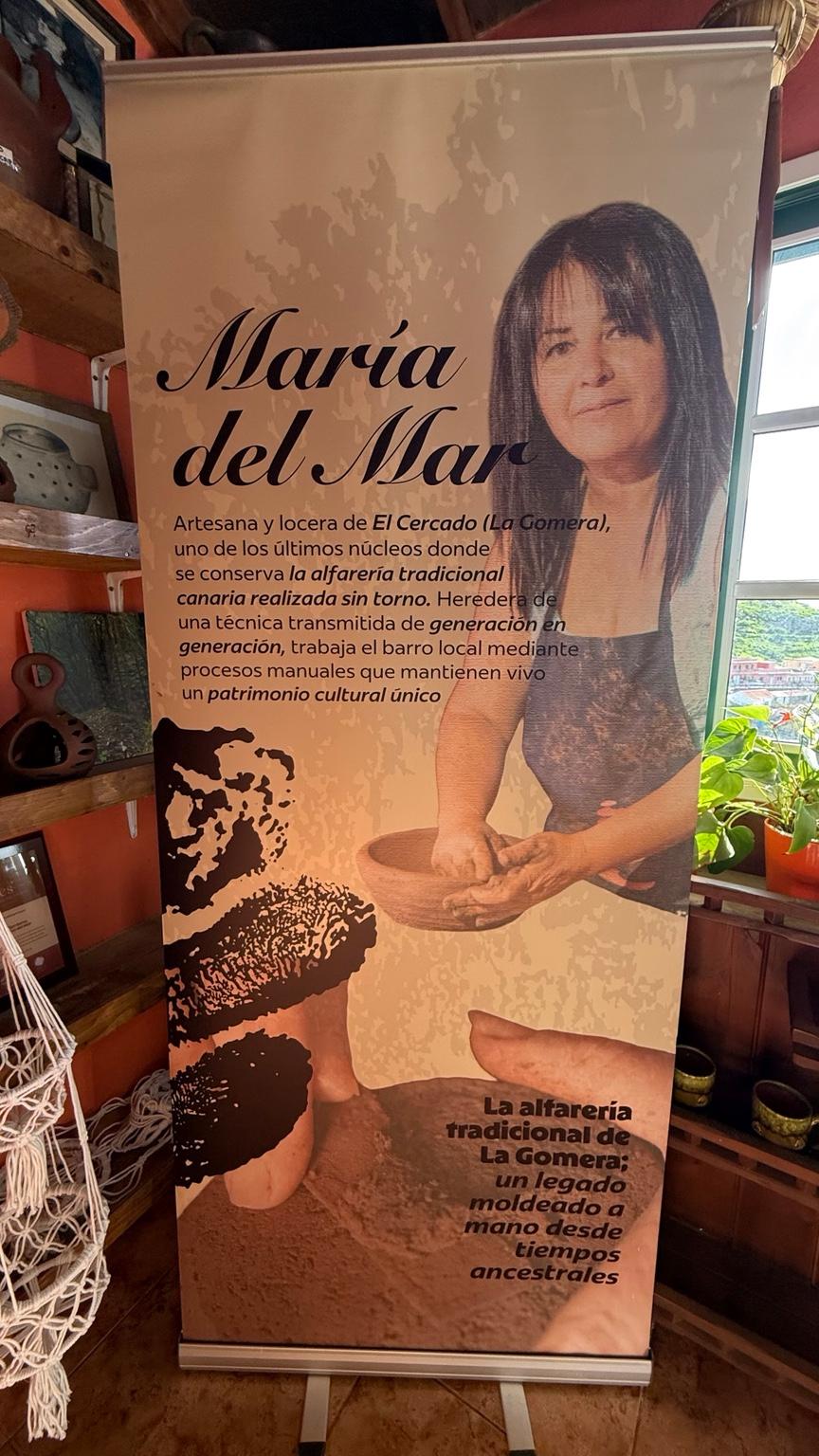
And then there are María del Mar’s own hands. In her portrait, she is bent over the clay, shaping a vessel. Look at where she places her fingers. It is the image I would choose to explain what working without a wheel means.
If you visit El Cercado independently, stop at the Centro de Interpretación Las Loceras too. You can follow a piece’s entire journey, from gathering the raw material to firing it in a wood-fired kiln. Seeing the stages helps you appreciate how much work lies behind that little jug you may have glanced at only briefly when you walked in.
Come with me to La Gomera
When we leave Los Cristianos by ferry and La Gomera appears on the horizon, the first thing we make out is its mountainous outline. From the sea, who would guess that up there a woman is making a dish by hand with a place for the mojo sauce?
That is part of why I enjoy being a guide so much. I can show you Roque de Agando, accompany you among Garajonay’s trees and tell you who lives on the other side of those mountains. On our excursion from Tenerife, we travel in a group of up to 18 people. Depending on the day’s route, we may also pass through El Cercado.
If you are thinking of coming, I would love to show you this island with time to notice the details and listen to its stories. You can check the dates and conditions of our small-group La Gomera excursion.
And to you, María del Mar, thank you. Thank you for continuing to make these pieces and for preserving something so much your own and so much a part of the island. The next time someone asks me what is worth seeing on La Gomera, alongside telling them about the forest, I will show them the photograph of your door.